


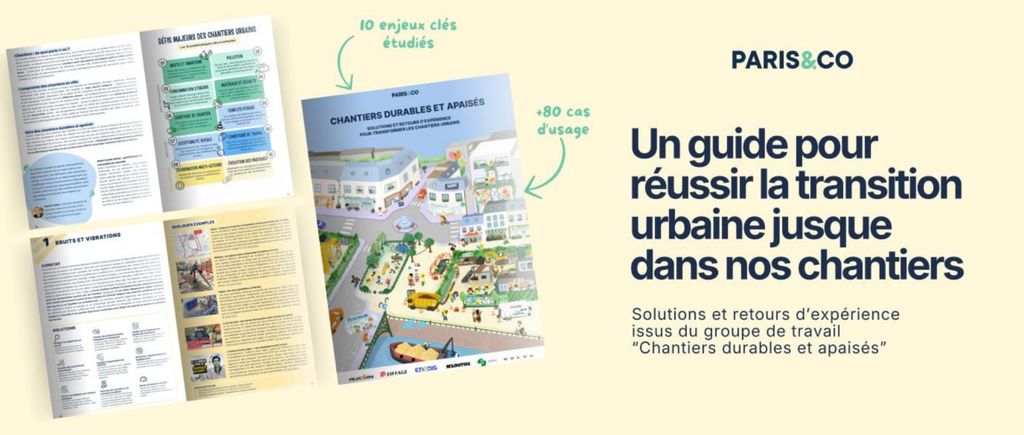
Paris&Co and its partners Alkern, Eiffage, Enedis, Kiloutou, Setec and Volvo Construction Equipment have announced the publication of the Guide to Transforming Urban Construction Sites, a groundbreaking resource produced by the ‘Sustainable and Calm Construction Sites’ working group. This guide offers an operational and collaborative framework for rethinking urban construction sites at a time when cities must balance modernisation, the green transition and quality of life.
A paradox at the heart of modern cities
The starting point for this initiative is a shared observation: densely populated cities constantly need to carry out construction work to build, renovate, maintain and modernise their infrastructure. These projects are essential for improving quality of life, strengthening urban resilience to climate risks, developing sustainable transport options and combating heat islands.
However, the increasing number of such projects creates major challenges: noise pollution, air pollution, congestion, waste management, impacts on land and biodiversity, social acceptability, working conditions, coordination between stakeholders… All these issues call for a profound transformation of practices.
A shared ambition: to create sustainable and peaceful construction sites
In the face of these challenges, one key question has guided the collective’s work: How can we collectively design construction sites that are more sustainable, more energy-efficient and better accepted in urban areas?
The guide published today provides concrete answers to this issue. It offers courses of action, lessons learnt and practical tools to support the entire sector in this transition.
A group of stakeholders committed to the entire value chain
The working group brings together a diverse range of stakeholders representing the full spectrum of construction trades: Alkern, Eiffage, Enedis, Kiloutou, Setec and Volvo Construction Equipment. Coordinated by Paris&Co, this group has been working for several months through a programme based on collective intelligence to bring together expertise, constraints, innovations and visions for the future.
An approach based on cooperation and openness
The approach is based on three pillars:
- Acting collectively: bringing together pioneering stakeholders to share best practices, innovations and feedback.
- Harmonising and equipping: producing shared resources, available as open source, to facilitate adoption by all professionals.
- Engaging the ecosystem: widely disseminating the collective’s findings to raise awareness across the entire sector and encourage the adoption of new models.
A tool to speed up the transformation of urban regeneration projects
The Guide to Transforming Construction Sites in Urban Areas is intended as a practical tool to support project owners, contractors, local authorities, design firms, network operators and those working on the ground in implementing construction projects that are more sustainable, more inclusive and more efficient. It marks an important step in the development of an industry committed to practices that are more responsible and better integrated with urban life.